In modern surveillance applications, in addition to common protocols such as ONVIF and RTSP, QNAP QVR Server now also supports RTMP (Real-Time Messaging Protocol)—providing greater flexibility in integrating various video sources.
Originally designed for live streaming needs such as encoders, drones, and mobile cameras, RTMP streams can now be directly received by the QVR Server. This allows users to easily incorporate these video sources into the monitoring system for both live view and recording.
For example, some TP-Link cameras can actively push their video streams to the NAS via RTMP. Once you set up the stream path and channel on the NAS, the video can be sent to the QVR Server smoothly—without relying on ONVIF compatibility.
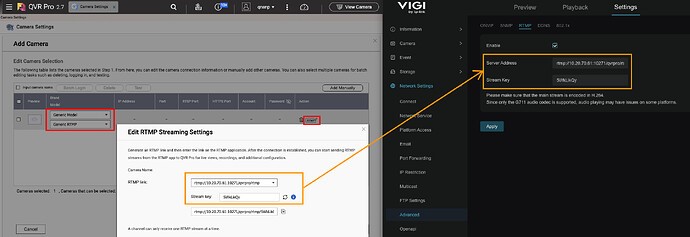
This push-based method is very practical, because as long as the NAS has a fixed IP address, cameras with dynamic IPs or from external networks can still send streams stably. This makes RTMP very suitable for temporary use, outdoor events, or mobile surveillance setups.
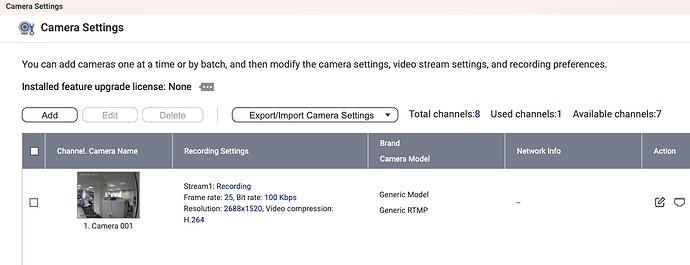
Another advantage is that RTMP does not depend on ONVIF compatibility, making it easier to integrate non-standard or third-party video devices.
With QVR Server, QNAP NAS is not just a storage center—but also becomes a control center for managing and integrating real-time video sources, helping to build more flexible and scalable surveillance solutions.