About NAS fixed IP configuration

I restarted the NAS, but the IP address has changed.
Because of this, the PCs that were set up to connect to the NAS can no longer access it.

I’m thinking of using the method described in this article to revert the IP address to the previous one and set it as static:

If I do this, will there be any issues such as not being able to access the NAS from QnapFinder?

Also, is it okay to leave the subnet mask and jumbo frame settings unset or at their default values?

If anyone knows, I would appreciate your advice.

@Ozeki

You will not be able to access the NAS unless the network address portion of the IP addresses for both the NAS and the PC are the same, so please pay attention to this.

–This may be unnecessary, but here’s a basic review of how IP addresses work.–
Regarding the “network portion of an IP address,” for example,
IP address: 192.168.100.1
Subnet mask: 255.255.255.0
In this case, the “network portion of the IP address” is 192.168.100.0.

In this scenario, as long as the network address portions are the same, for example:
PC: 192.168.100.10 (subnet mask 255.255.255.0)
NAS: 192.168.100.11 (subnet mask 255.255.255.0)
If you set them like this, you will be able to access the NAS.

–Special IP addresses–
Sometimes you may see a network address like
169.254.xx.xx
This kind of address appears when neither a static IP is set nor a DHCP server is available.
In this case, the address may change if the NAS or PC is restarted.
If this is the case, by “setting both devices to static IPs” or “preparing a DHCP server (usually the router acts as the DHCP server),” you can generally fix the NAS IP address and access it reliably.

–Notes when using static IPs–
If you use static IPs and there is also a DHCP server on the network, there is a risk that the IP address may conflict with another device. If IP addresses overlap, communication will fail.

In such cases:

  • If there is no DHCP server, you can simply assign static IPs to both the PC and NAS without any issues.
  • If there is a DHCP server, set the PC and NAS to IP addresses outside the range distributed by the DHCP server. (For example, if the DHCP server is set to assign IP addresses from 192.168.100.10 to 192.168.100.100, you could use 192.168.100.201 and 192.168.100.202 for your devices.)
    Alternatively, you can configure the DHCP server to reserve specific IP addresses for specific MAC addresses.
    You will need to make such settings as appropriate.

This has become a long explanation, but whether or not you will lose access depends on your current IP address settings and the IP address settings you are planning to change to.

If possible, if you could provide a simple network diagram and information about what you are trying to do, I could give more precise advice.

I would appreciate it if you could check these points.

I didn’t mention jumbo frames earlier, but I recommend setting jumbo frames to disabled (or the default setting) at least until normal communication is confirmed.

Once you have confirmed that communication is working properly, it would be best to change the NAS settings first, then change the PC settings in that order.
Another concern is whether other network devices support jumbo frames, so I personally do not use jumbo frames at home.

Thank you very much for your thorough explanation.
Since I have no expertise regarding networks, I truly appreciate your detailed explanations.

The NAS is something we use at the company, and to explain further, when we conducted a power outage check at the office, it seems that we also ended up rebooting the NAS.

At that time, we also rebooted the router.
I’m not entirely sure, but I believe there is a DHCP server, and it seems that after rebooting the PCs and NAS within the company, the IP addresses were reassigned. (Therefore, I think there are probably no issues with the network side.)

My understanding is that the IP address previously assigned to the NAS was also automatically assigned by the router, and with this recent reassignment, it’s possible that the IP address previously set for the NAS has now been assigned to another device.

The router is contracted through NTT, but I have never accessed the router’s management screen before, so I’m not familiar with the DHCP server’s assignment range;;

I apologize for the additional questions, but:
Is there a default value for the IP address range distributed by the DHCP server?
Also, if an IP address you want to specify (let’s call it IP-A) has already been assigned to another device, is the idea that you would reserve IP-A as a reserved IP and reassign it to the desired device via the router’s management screen?

Also, the issue of not being able to access it is only occurring on some PCs. There are PCs that can normally detect the network and open the NAS, but for security reasons, there are also PCs that access the NAS by specifying a fixed IP address, and it is these latter PCs that are unable to access it.

I believe that if we reconfigure the settings with the newly assigned IP address, those PCs will be able to access it, but since there are many such PCs, if possible, I would like to return the NAS itself to its original IP address and prevent similar issues from happening again in the future.

@Ozeki

I see.
Normally, a DHCP server has a “lease time” setting that determines how long an IP address is assigned. During the lease period, even if the client is not found on the network, the server will not assign that IP to another device. If the lease time is exceeded and a new client requests an IP, the server may assign that IP address to the new client. That’s how it works.

Since your router was stopped for a certain period, I suspect the lease time was exceeded and the DHCP server reassigned IP addresses to almost all devices under its control.

My understanding is that the IP address previously assigned to the NAS was also automatically assigned by the router, so with this reassignment, it’s possible that the IP address previously set for the NAS has now been assigned to another device.

Yes, your understanding is correct.

Is the IP address range distributed by the DHCP server set to a default value?

My understanding is that it depends on the manufacturer.

Also, if the IP address you want to specify (let’s call it IP-A) has already been assigned to another device, is the idea to reserve IP-A as a static IP and then reassign it to the desired device via the router’s management interface?

Yes, that’s generally correct.
Depending on the manufacturer, you may need to remove the device currently using IP-A from the network so that no client is using that IP, and then set that IP as a reserved address. Some routers require this procedure.

For security reasons, there are PCs that access the NAS with a fixed IP address, and now those PCs can no longer access it.

I’m not sure I understand the security reasons, but if you don’t mind sharing.
If you’re setting a static IP on the client side, it’s probably better to have the DHCP server assign a fixed IP as well.
From my past experience, sometimes static IPs don’t work well because the route information isn’t clear. In a DHCP environment, the DHCP server usually acts as the gateway, so if there’s an issue, devices tend to “ask the gateway device,” which seems to work.
(Sorry for the vague explanation. I’m guessing it could be something like the gateway isn’t set, or a static routing mismatch occurred because the IP address changed.)

With the QNAP Qhora router we use, it works like this with static IPs.

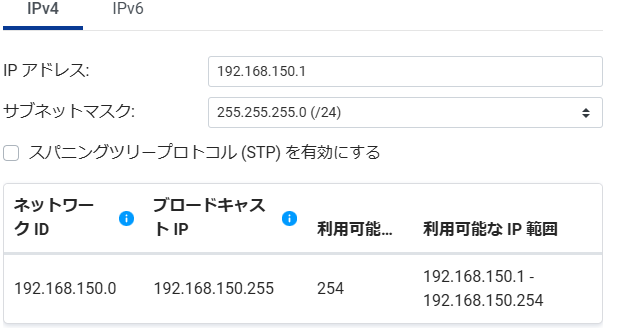
Qhora allows you to set reserved IPs from within the “DHCP-assigned IP address range,” so the assignment range looks like this.

Do you know the manufacturer and model number of the router you are using?
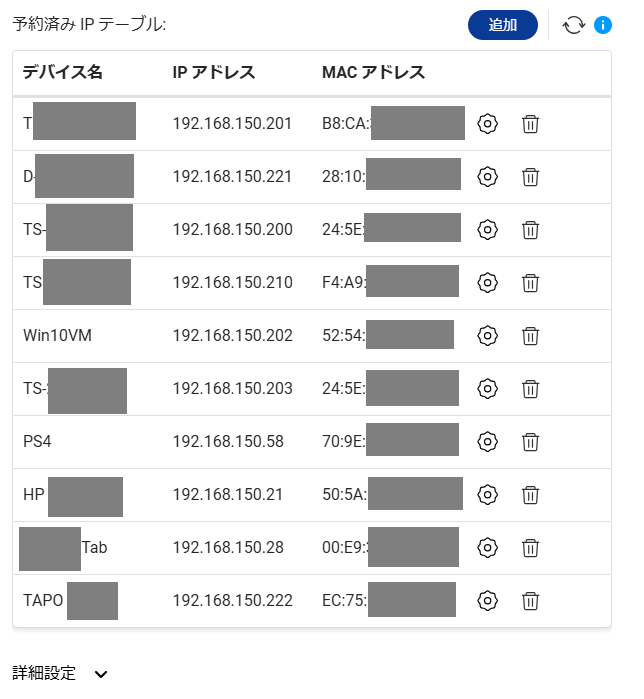
I just did a quick search, so the model might be different, but if it’s an NTT router, it seems you can set it up like this.

https://web116.jp/shop/hikari_r/guide/500ki/4-w/8w_m4.html

I am truly grateful for your kindness in sending not only the attached screenshots but also reference sites for router settings. Thank you very much.

I’m glad to learn that there is a function that allows you to specify IP address assignments from the DHCP server to each device!

Although the router is from NTT, all network-related matters are managed by Ricoh, so it’s possible that the DHCP settings are handled on the Ricoh side. For now, I will check if I can configure the settings using the reference sites you provided, and I also plan to contact Ricoh.

That’s right.
If Ricoh is managing the network, I think it’s best to consult with them directly.
(If you change things on your own, you might get in trouble.)

It would be good to clearly specify the IP you want to set for the NAS and consult with them by saying, “I want the IP assigned to the NAS by the DHCP server to be this IP.”

If you have any further questions, please feel free to contact me.

1 Like