Qnap NAS: feature requests/suggestions

QNAP NAS devices feature AppCenter, allowing you to add and use a variety of functions tailored to your individual needs. However, we believe there are still areas that can be improved by listening to your feedback.

There is also a possibility that “the latest version already supports that,” so when posting in this topic, please provide information by filling out the following items!

NAS in use:
OS version in use:
App name (if requesting for an existing app):
App version (if requesting for an existing app):
Request/Requirement:
Background of the request/requirement:

We look forward to receiving your feedback!

So, I’ll be the first to post.

NAS in use: TS-264
OS version in use: QTS 5.2.0.2860
App name (for existing app requests): Qsirch
App version (for existing app requests): 5.4.2-88af5a
Request/Requirement: I would like to be able to search by folder name.
Background of the request/requirement: In some apps, the “project name” is used as the “folder name,” and related project files are saved inside the folder. In this case, to search for a project, it is necessary to search by folder name, so I would like to be able to search by folder name.

This is regarding the ticket I previously created with QNAPSupport, but I would also like to submit my request directly.

NAS in use: TS-453A
OS version in use: QTS 5.2.3.3006
App name (for requests regarding existing apps): VirtualizationStation
App version (for requests regarding existing apps): 4.0.0.256
Request/Requirement: Addition of a feature to reduce the size of virtual hard disks
Background of the request/requirement: In order to secure free space on the volume, I attempted to reduce the size of an existing virtual hard disk.
On the virtual machine side, I shrank the partition that was using 250GB down to 150GB, creating 100GB of unallocated space.
After that, when I tried to reduce the virtual hard disk size from the virtual machine edit screen in VirtualizationStation 4,
I received the message:
“You cannot reduce the hard disk size any further.”
and was unable to apply the change.

As a temporary workaround, I exported the virtual machine in OVF format, imported it into VMBOX, compressed it with vboxmanager, then exported it again in OVF format and imported it back—this required three steps.
Another method would be to create a new 150GB virtual hard disk, mount it to the virtual machine, clone to the 150GB side using the dd command, and then delete the 250GB virtual hard disk. However, I gave up on this because the host volume was running out of space.

Other hypervisors allow shrinking on their own, so it would be very helpful if this could be done entirely within QNAP.

This is a request from a “hypervisor refugee” who emerged due to the discontinuation of the free version of ESXi.

1 Like

@Mikan

Regarding this, what was the status of the virtual HDD?

Since you were able to shrink it down to 150GB, I assume that the actual usage of the virtual HDD was also below 150GB.
Also, in VirtualizationStation, virtual HDDs are thin-provisioned, so I assume that the actual capacity of the virtual HDD as seen on the NAS was also below 150GB.
If there is a possibility, it might be that when a snapshot of the virtual machine is taken, the old data of the parts overwritten after the snapshot could become bloated. In this pattern, there are cases where “the area used by the snapshot is not released even after the snapshot is deleted,” but I would like to ask in detail about the situation.

Was it that you wanted to shrink the size of the HDD as seen from the virtual machine, rather than the actual usage on the NAS?

I apologize for asking so many questions, but I would appreciate it if you could confirm.

I’m still a beginner no matter how much time passes.
NAS in use: TS-364
OS version in use: QTS 5.2.3.3006
Background of request/requirement: At first, I installed apps indiscriminately and ended up consuming too much CPU and memory. Gradually, I’ve been deleting unnecessary apps, but since I installed them without really understanding what they do, I’m unsure whether it’s okay to delete them.
My purposes for using the NAS are: (1) storing data from my old PC, (2) saving materials for online courses, (3) countermeasures in case my main PC crashes, etc. I want to learn more ways to use my NAS conveniently, so I appreciate your continued support.

1 Like

@baku51

I often end up in the same situation myself, lol.
When deleting an app, I first “stop” it and observe for a while, then if there are no issues, I proceed to delete it.

① Saving data from the old PC
② Saving materials from online courses
③ Crash protection for the main PC

Regarding crash protection, my impression is that you might use apps like Qsync or HBS3 to synchronize files.

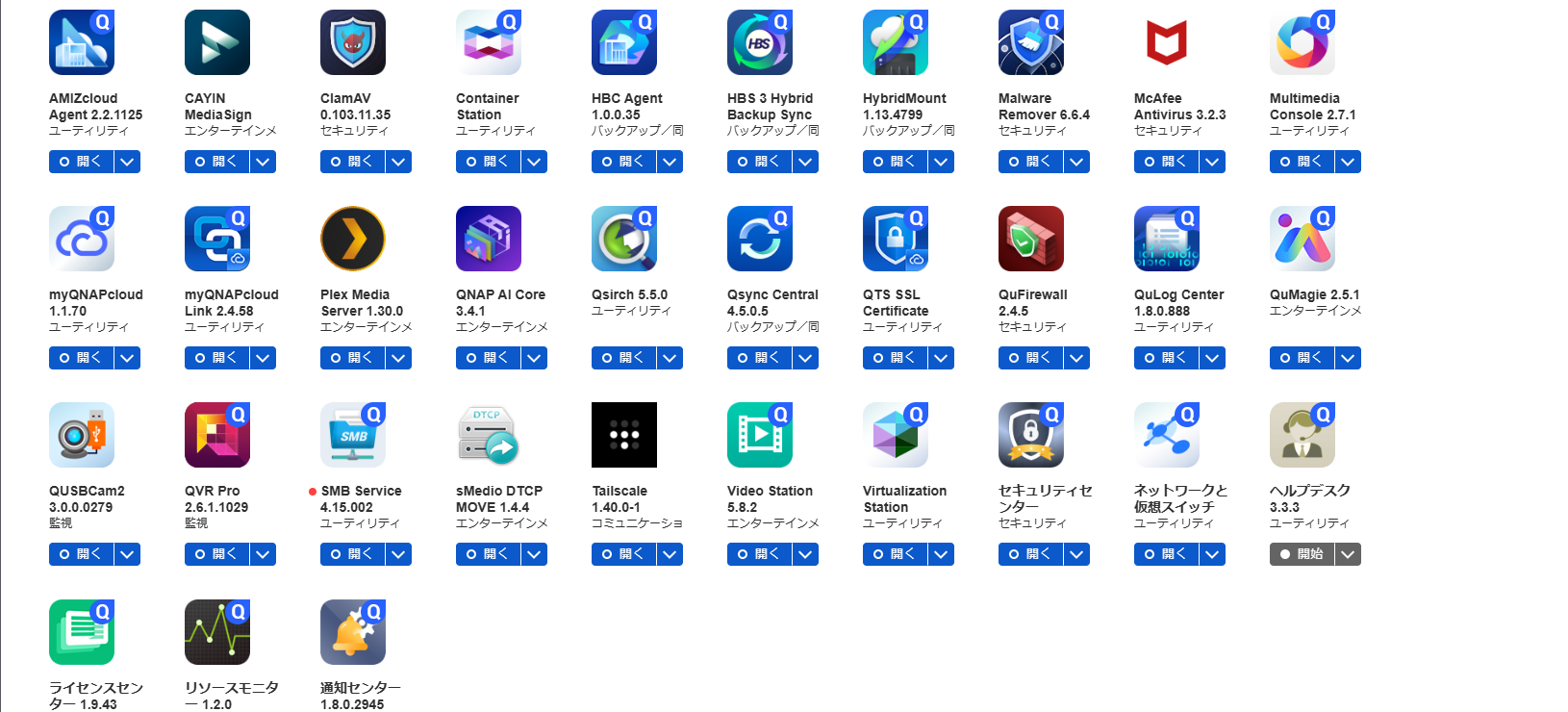
On my NAS (TS-264), the apps are installed like this. I hope this is helpful.

Thank you very much for your prompt reply, Harinezumi. Your advice was extremely helpful. I look forward to your continued support.

NAS in use: TS-673A
OS version in use: QTS 5.2.3.3006
App name (for requests regarding existing apps): QuMagie and Multimedia Console
App version (for requests regarding existing apps): QuMagie 2.5.1, Multimedia Console 2.7.1

Request/Suggestion:
Please do not display files excluded from thumbnail generation in Multimedia Console on QuMagie.

Background of the request/suggestion:
In the predecessor application, Photo Station, specified files were not displayed as thumbnails and remained hidden, but in QuMagie, they are now displayed.

1 Like

@Perorinn

Thank you for your feedback!
We have forwarded your comments and requests to the development team.
Thank you for your valuable input.

1 Like

@Perorinn Since QuMagie 2.2.0, even if thumbnails for images have not been created, it tries to display thumbnails for JPG and PNG images in the browser. This might be the cause.

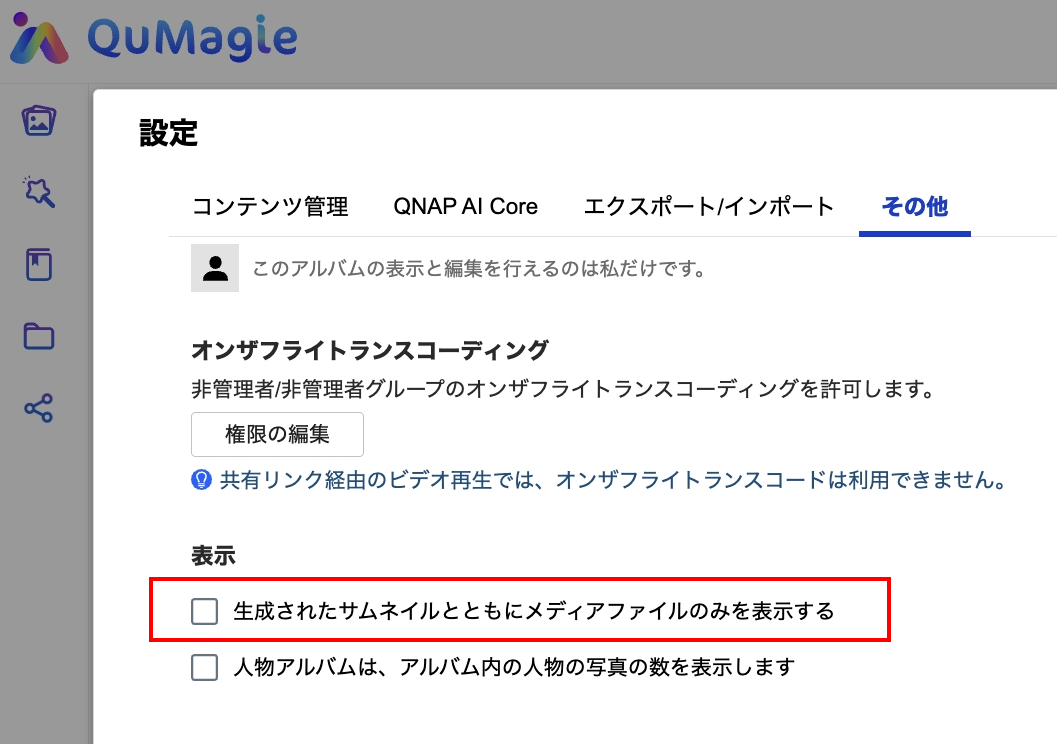
QuMagie has an option in its settings called “Display only media files with generated thumbnails.” Could you try enabling this option?

For example, if you set Multimedia Console not to create thumbnails for HEIC images and enable the “Display only media files with generated thumbnails” option in QuMagie, HEIC images will no longer appear in QuMagie’s list.

2 Likes

Checking this solved the issue! Thank you.

2 Likes

NAS in use: TS-216G
OS version in use: QTS 5.2.4.3079
Request/Requirement:
I would like to be able to disable the myQNAPcloud service.
Background of the request/requirement:
In my usage scenario, it is sufficient to access only within the local network, so I would like to be able to disable the myQNAPcloud service when it is unnecessary, in order to reduce limited resources. There is no option to stop or delete it in AppCenter. Also, even when logged out, it frequently communicates with myQNAPcloud endpoints.

1 Like

The ticket ID at that time was “Q-202009-29141”.
I set the capacity to 250GB on the virtual HDD and installed Windows Server.
As I added applications and data to the WS, the C drive increased from 80GB to 90GB, and in some cases, the IMG file side increased from 80GB to 100GB, growing even larger than the actual data.
I contacted the help desk, and as a temporary measure, I reduced the C drive format size from 230GB to 180GB to prevent exceeding the thick volume.
At that time, I was told, “Once the IMG file has grown, it cannot be reduced in size.”
As you may infer from the ticket ID, this was nearly five years ago, so it may have already been improved.

1 Like

NAS in use: TVS-h674
OS version in use: 5.2.3.3006
Request/Requirement:

(1) Domain users do not appear unless refreshed. Domain groups are displayed automatically without any action.
(2) When linked with AD, deleted users in AD are synchronized upon refresh, but information assigned to shared folders is not deleted.

Background of the request/requirement

(1) Why do domain users need to be refreshed every time, even though domain group information remains?
(2) I wrote two requests because (1) and (2) might be related.

When an employee leaves the company, they are deleted from AD. On QNAP, this is reflected by refreshing domain users. However, users [deleted in AD] who were assigned to shared folders are not deleted, so they must be removed manually.
If there are many shared folders, this task is very burdensome.
Since the user has already been deleted from AD, I don’t think they will be used, but it’s concerning that only the information remains. Updating user information may take a considerable amount of time, so I would like user information to be organized at a specified time or at some timing.

1 Like

I apologize for bringing up an app that is not available in AppCenter…

NAS in use: TS-673A
OS version in use: QuTS hero h5.3.1.3292
App name (if this is a request for an existing app): SyncThing
App version (if this is a request for an existing app): 2.0.11
Request/Requirement: I would like it to support both AppCenter and HA.
Background of the request/requirement: I tried HA as a test. It seemed quite good, but the main drawback is that basically only apps registered in AppCenter can be used. I use several apps provided by MyQNAP. I can give up on other apps, but I just can’t let go of SyncThing. I apologize for being selfish, but I would greatly appreciate it if you could make it compatible with HA.

NAS in use: TS-877XU-RP
OS version in use: QTS 5.2.8.3359
App name (if this is a request for an existing app): NVIDIA GPU Driver
App version (if this is a request for an existing app): 5.2.0.1225
Request/Requirement: I would like the update cycle for the NVIDIA GPU Driver to be faster.

Background of the request/requirement:
To use AI workloads on Container Station/Virtualization Station, I installed an NVIDIA RTX Pro 2000 Blackwell on the TS-877XU-RP, but it was not recognized. It seems that the NVIDIA Driver 5.2.0 available for installation from App Center does not support the Blackwell generation. In the cautionary QA for NVIDIA Driver 6.2.2, the names RTX 5000 and RTX Pro are mentioned, so I believe 6.2.2 may support them. I would appreciate an early release.

Screenshot 2026-01-25 212007

Screenshot 2026-01-25 212007811×364 15.4 KB

I remember that the RTX A2000 (Ampere), which I installed earlier, was also not recognized right after its release, and I had to wait almost a year for support. I guess I haven’t learned my lesson either…

NAS in use: TS-473A
Operating system version in use: QTS 6.0.0.3398
Application name (if request is for an existing application): NVIDIA GPU Driver
Application version (if request is for an existing application): 6.2.2.1106
Request/Requirement: Hope the update cycle for NVIDIA GPU Driver can be accelerated to support NVIDIA RTX Pro 2000 Blackwell

Background of the request/requirement: In order to run AI workloads on Container Station/Virtualization Station, I installed NVIDIA RTX Pro 2000 Blackwell on the TS-473A, but the system cannot recognize it. The NVIDIA Driver 6.2.2.1106 available in App Center uses nvidia-driver 575.64.05, which should support Blackwell. However, NvKernelDriver 6.0.0.3397 is a dkms-driver using version 550. I sincerely request that the kernel driver be upgraded to the corresponding version as soon as possible and support be provided.