Minimum capacity requirements for HDD/SSD usable with QTS

I checked this out because I needed to, but I thought others might be interested as well, so I’m sharing it here.

As the title suggests, the topic is: “What is the minimum capacity HDD/SSD that can be used with QTS?”

Based on my research, my conclusions are:

  • If you use a storage pool, 144GB (preferably 200GB or more)
  • If you use a static volume, there doesn’t seem to be a specific lower limit; practically about 32GB

【Minimum capacity listed on the compatibility list】
I checked the compatibility list for my TS-264.
https://www.qnap.com/ja-jp/compatibility/?model=635&category=1&filter[type]=1

Here, Apacer’s 32GB is listed as the product with the minimum capacity of 32GB.
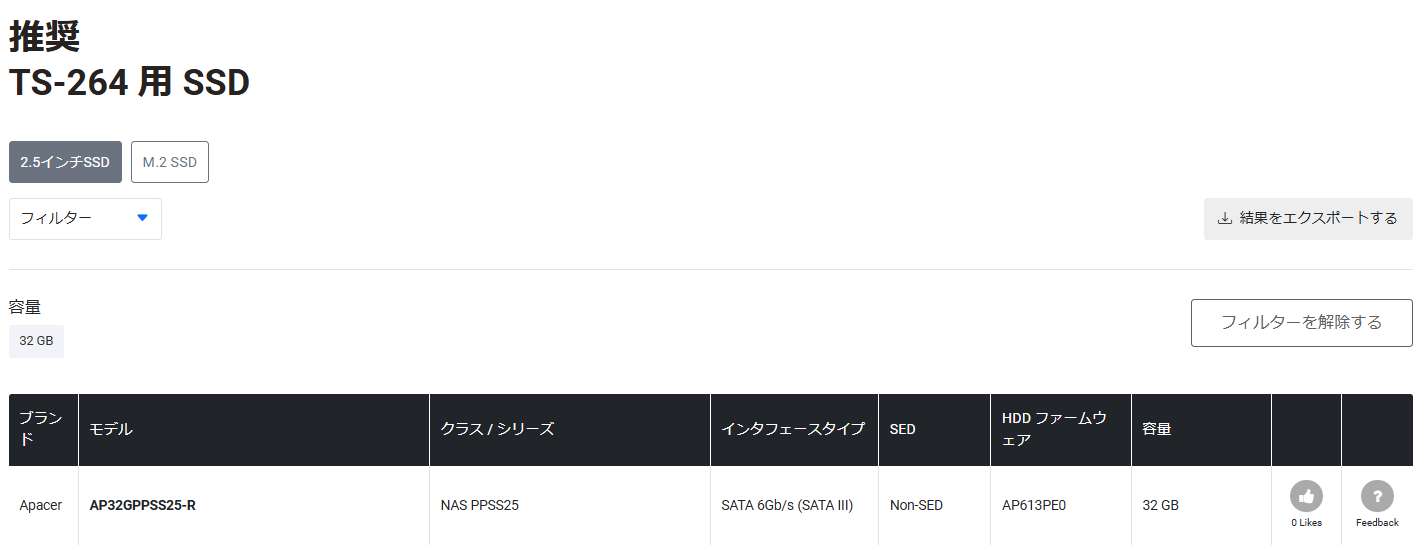
From this, I understood that a 32GB SSD can probably be used without any issues.

【Minimum capacity based on storage pool specifications】
When searching for “QNAP minimum capacity,” I found the following FAQ.
https://www.qnap.com/zh-tw/how-to/faq/article/what-is-the-minimum-capacity-requirement-if-i-would-like-to-create-a-storge-pool-in-qts

This states:

  • Storage pools require at least 144GB. 200GB or more is recommended.

From this, I understood that you probably can’t build and use a storage pool unless you have an HDD/SSD of at least 144GB.

【What’s the difference between 32GB and 144GB?】
Although the compatibility list includes a 32GB SSD, it seems that at least 144GB is required. In reality, 144GB is the minimum capacity for building a storage pool, so if you use a static volume, you can use less than that.

【Summary】
If you just need “computing” resources, it’s easy to think “as long as the storage is minimal, it’s fine,” but now I know what the minimum capacity is.
As I mentioned at the beginning,

  • If you use a storage pool, 144GB (preferably 200GB or more)
  • If you use a static volume, there doesn’t seem to be a specific lower limit; practically about 32GB

That seems to be the case.

I hope this is helpful to everyone.

2 Likes

@Harinezumi

I didn’t know it could run on storage even smaller than recent SD cards! That’s new to me.
Since you can add RAID volumes later and expand the capacity, I think a storage pool is recommended.

However, if you only need it for “computing” (I wonder how it can be used…), then minimum storage capacity should be fine.
Is it for running as an MQTT gateway, or running simple scripts on the base Linux system, something like that?
Ah, but certainly, you can run it as an FTP server, and it might be convenient to send files from a client via FTP and then transmit them over MQTT.

I learned a lot!

It’s a bit late, but I’ve been thinking about possible uses for small-capacity storage.
The most likely use case would be when you want to separate “boot/system storage” and “data storage.”
Looking at the documentation, it seems that the official recommendation is also to separate boot/system storage and data storage—or rather, to use SSDs for boot storage.
If you use it only as boot/system storage, the storage capacity doesn’t need to be very large, so as long as you have the required 144GB or more for the storage pool, it should be generally sufficient.

Most recent QNAP NAS devices have two M.2 slots “for cache” in addition to the 3.5-inch bays, so I think it’s a good idea to insert two M.2 SSDs there, use them in RAID 1 as “boot/system storage,” and use the entire area of the HDDs installed in the 3.5-inch bays as “data storage.”

From here, this is a side note about using the ZFS file system with “QuTS hero.” The ZFS acceleration mechanisms “L2ARC” and “ZIL-SLOG” are generally difficult to make effective in normal operation, and it tends to be simply “better to have a lot of DRAM.”
Also, if you set up “L2ARC” or “ZIL-SLOG,” in the event that the NAS itself fails, the advantage of ZFS—where RAID configuration information is stored on the storage side and you can recover by swapping the unit and reinserting all the storage—is lost. So, at least with “QuTS hero,” I think it’s better to use the M.2 slots provided for cache as “boot/system storage” rather than for cache, and if you need cache, rely on having a large amount of DRAM.
Note: Recovery by swapping the unit and reinserting all storage is not limited to QuTS hero using ZFS; it seems possible with QTS using ext4 as well, but reliable recovery is not always guaranteed with either QTS or QuTS hero.
Therefore, backup “in addition to the NAS” is essential.
Also, in the case of QTS, if you enable “QTier,” recovery seems to become difficult just like with QuTS hero, so for safety, it might be better not to enable cache too easily.

2 Likes

@bel
I see. It’s a concept similar to separating the C drive and D drive.

With QNAP products, if you create multiple storage pools, you can choose which one to install applications on. If you install the application itself on an SSD, the app will launch faster, so it’s recommended.

If you use “SSD cache” and end up in a situation where “data not written to any disk exists only on the SSD,” recovery can be difficult in case of a failure, so please be careful.
(If you need high-performance writing, we generally recommend an all-flash configuration rather than HDD+SSD write cache.)

You can check here to see if you can migrate directly by reinserting the HDDs:
https://www.qnap.com/ja-jp/nas-migration/

As for data, basic migration is possible.
However, application settings and installed apps cannot be migrated if the CPU architecture is different.

I hope this is helpful.

1 Like