Since Proxmox VE has recently been gaining attention as a virtual machine environment, I’d like to share the steps and behavior I confirmed when connecting from Proxmox to a HA-configured QNAP NAS for use.
Preparing the Proxmox VE Environment
I won’t go into the finer details this time, but you’ll need to install Proxmox VE. The installation ISO file can be obtained from the link below:
After downloading, write it to a USB flash drive to create a bootable installation media.
Connect the created installation media to the hardware where you want to install Proxmox VE, boot from USB, and proceed with the installation.
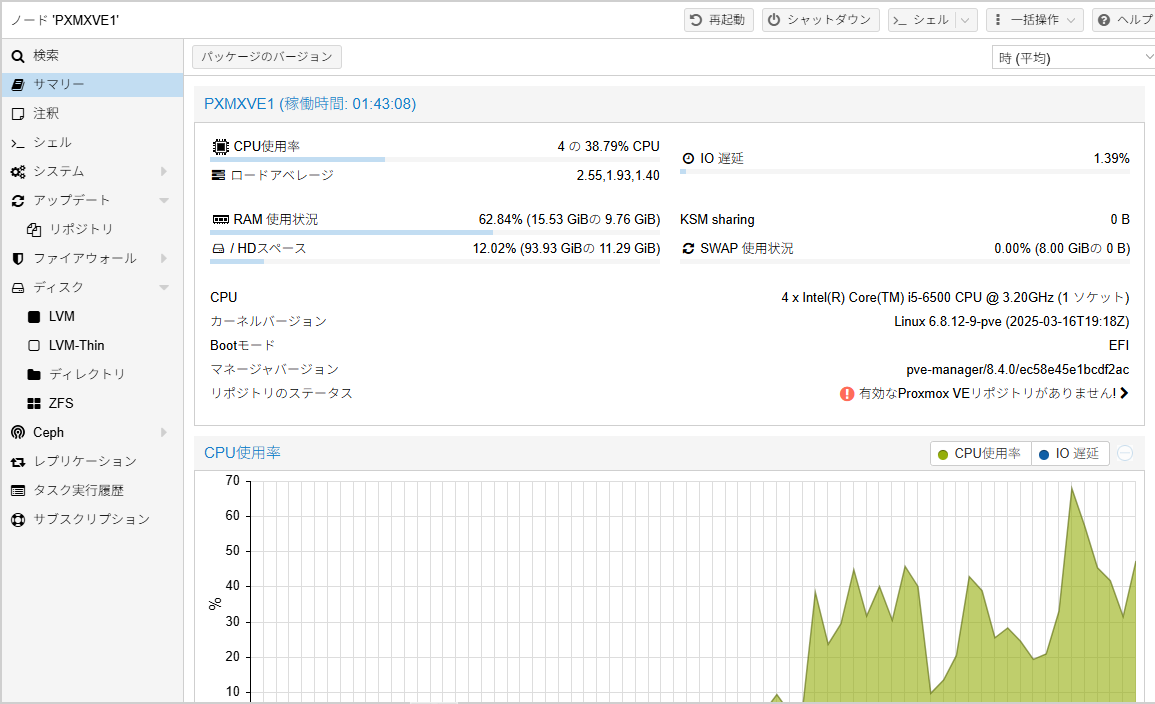
This time, I installed Proxmox VE on an old evaluation NAS (TVS-882T) that I no longer use.
iSCSI Connection
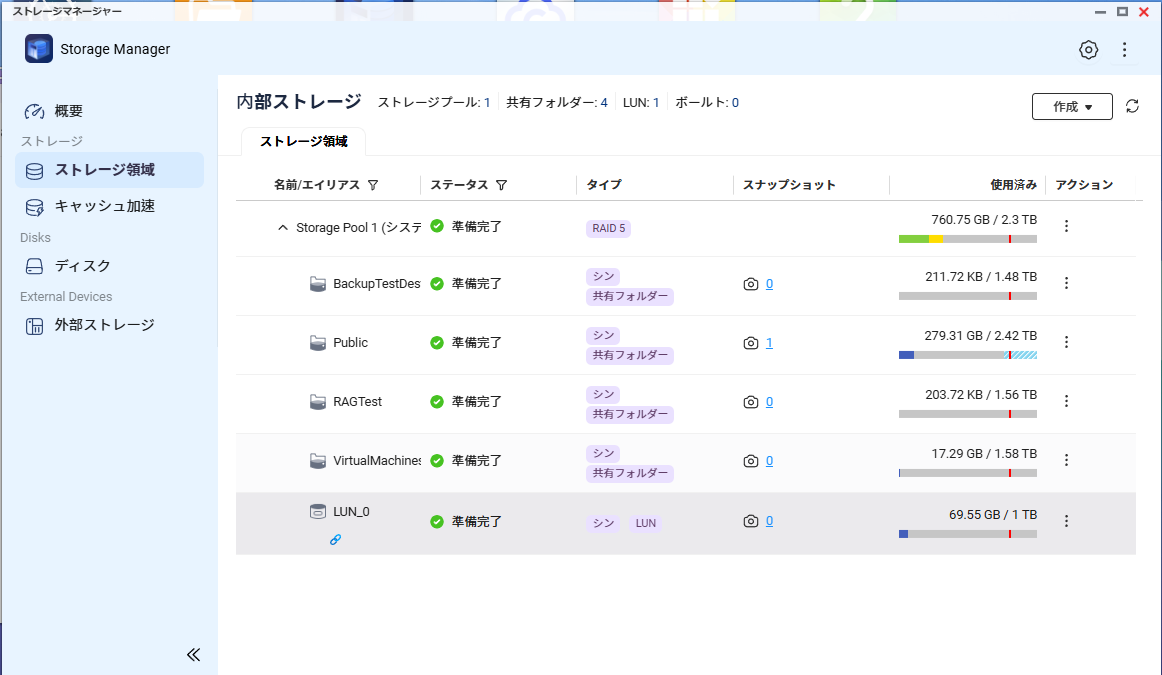
When using Proxmox VE, it seems you can use both iSCSI and NFS, but I tried iSCSI first. In the NAS Storage Manager, create an iSCSI LUN.
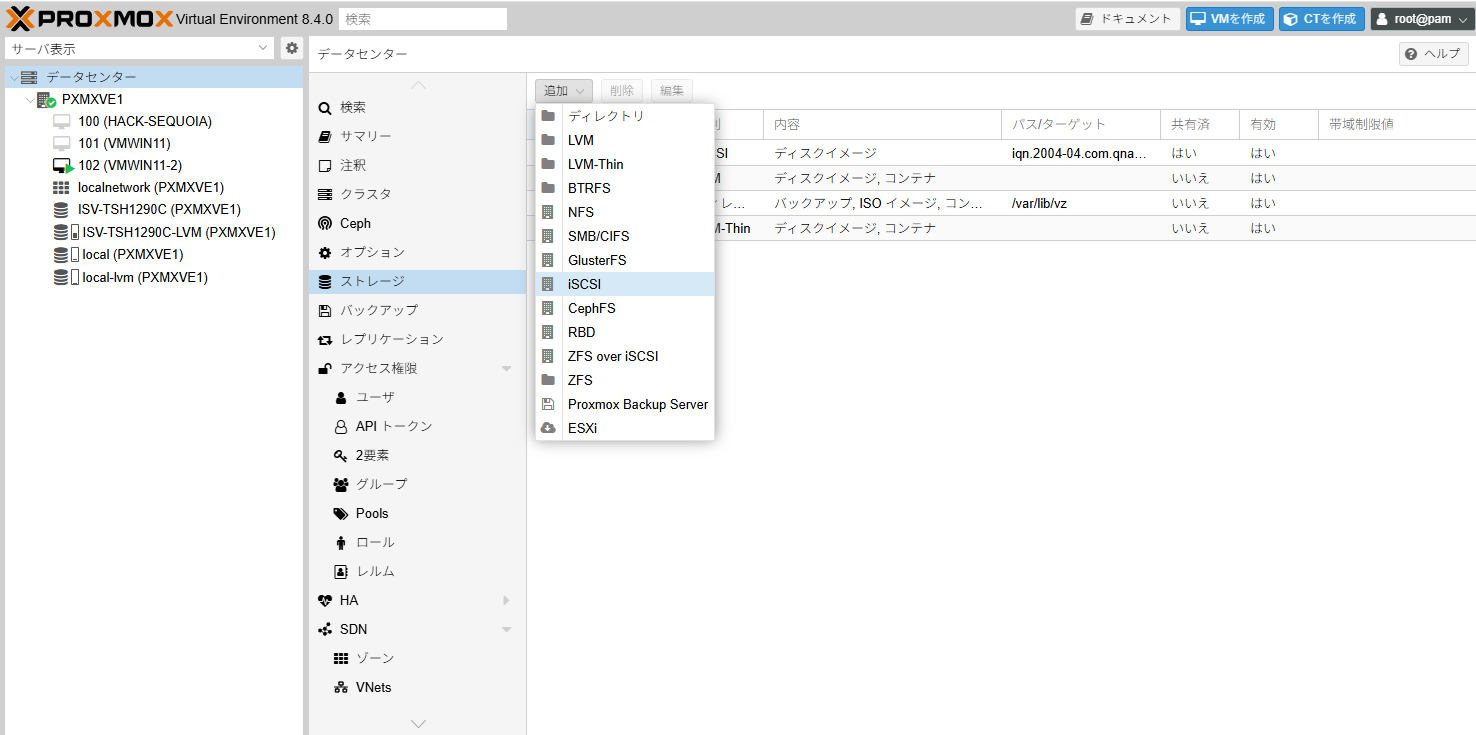
In the Proxmox VE environment, select [Datacenter] - [Storage] - [Add] - [iSCSI],
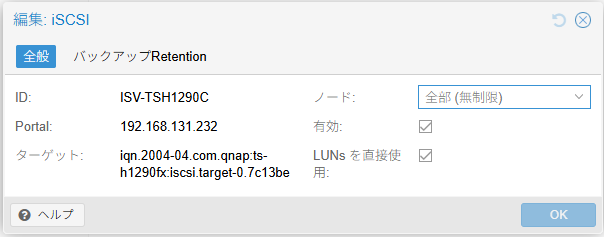
Enter the ID (device name on Proxmox VE) and portal (QNAP NAS IP address), and you’ll be able to select the available (exported) LUNs. Choose the LUN you want to use with Proxmox VE.
At this point, the iSCSI volume is recognized as a disk, but additionally, I made the disk into an LVM. (With VMWare, I think you would format with VMFS, but using LVM seems to be the “ritual” to make it usable on Proxmox. ZFS over iSCSI might also work…)
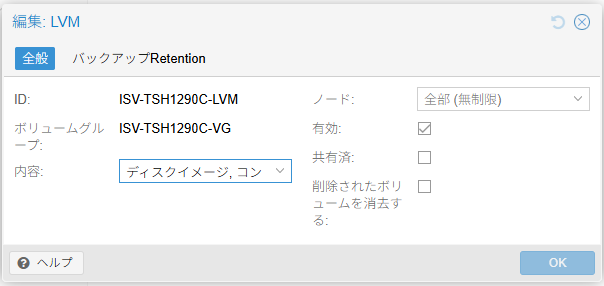
Once you’ve done this, you can select the iSCSI device as the storage destination when creating a virtual machine.
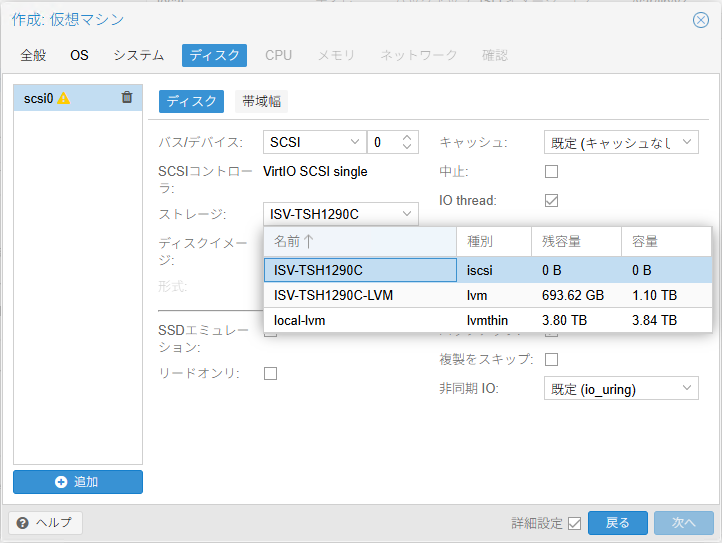
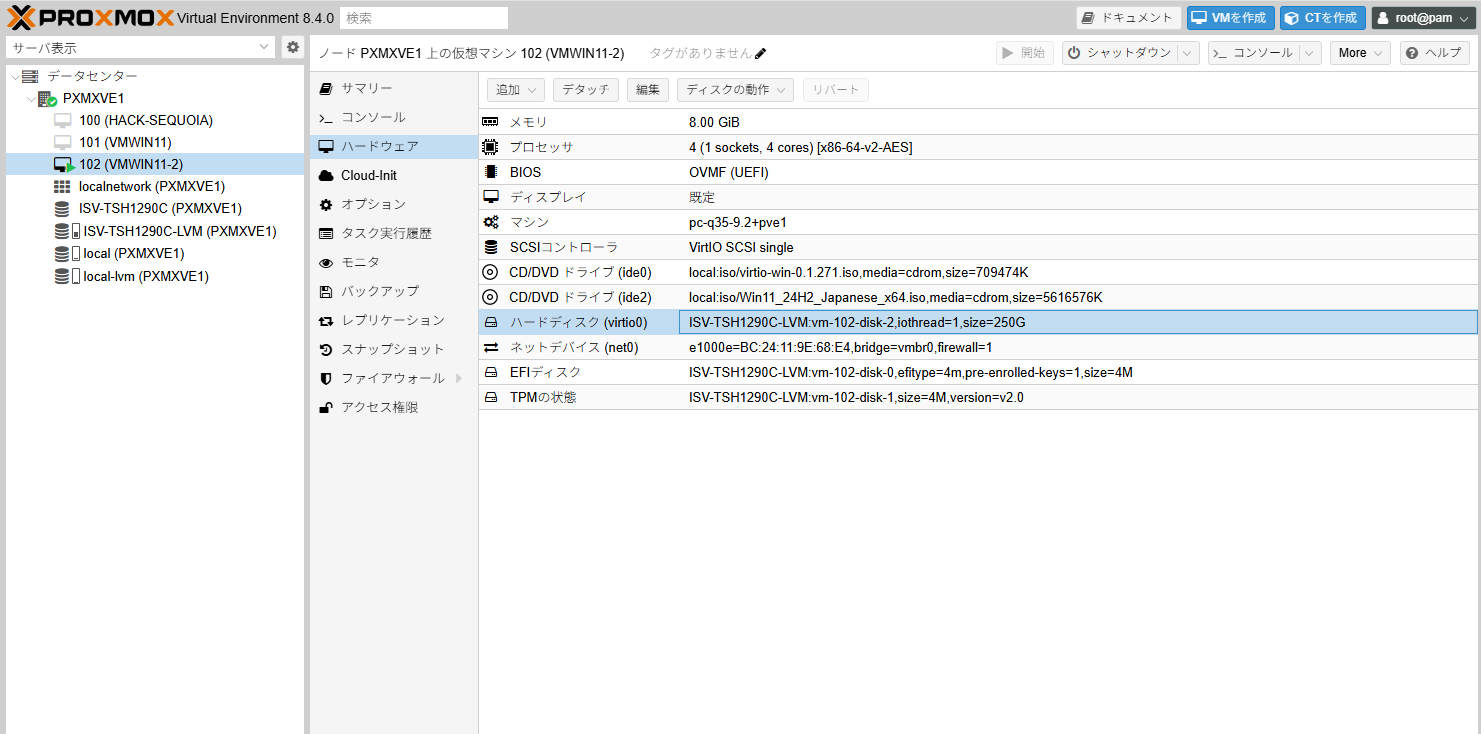
I actually created a volume using the iSCSI disk and installed Windows 11, and it works like this.
Performance from the VM
The environment this time is as follows. (For instructions on building an HA configuration with TS-h1290FX, please check here.)
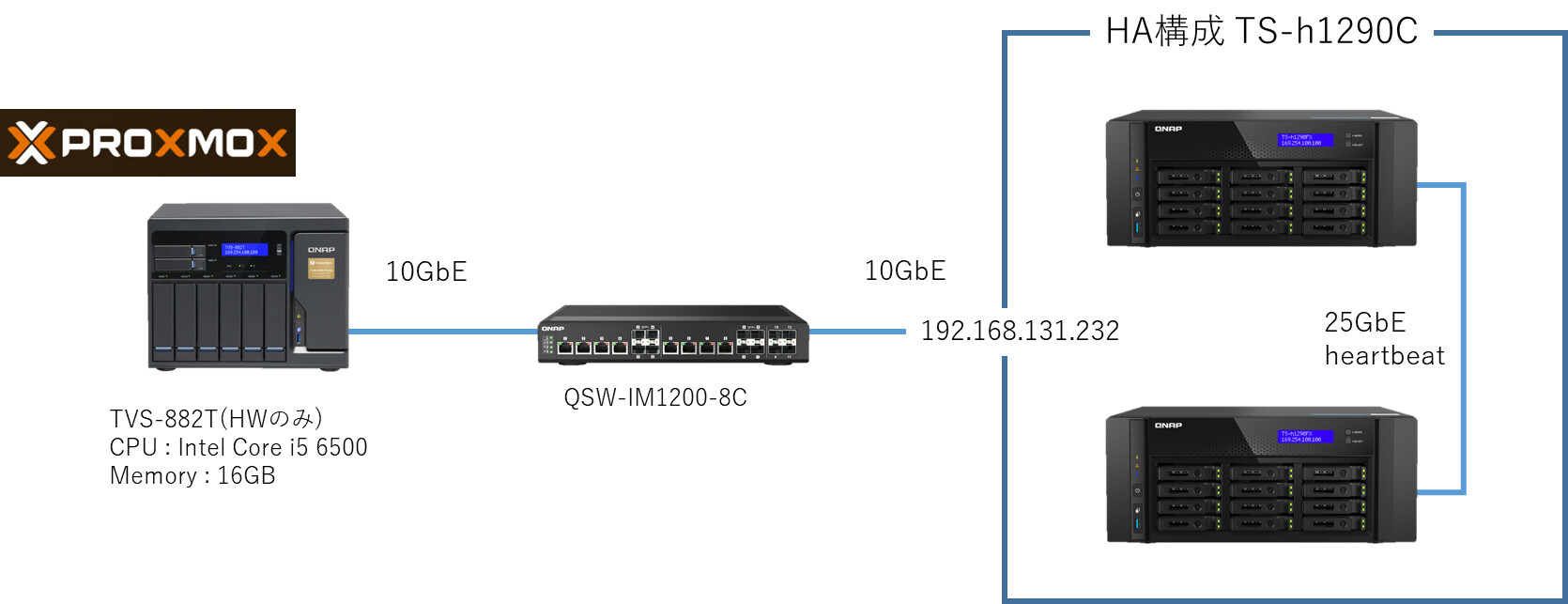
Proxmox VE and the switch are connected via 10GbE.
The TS-h1290FX is configured as an HA setup with two units, with a 10GbE connection on the front side and a 25GbE connection for Heartbeat.
I installed Windows 11 Pro on Proxmox VE and set the disk image storage location to TS-h1290C (on the HA cluster), then measured the local drive speed.
The results measured with CrystalDiskMark are as follows.
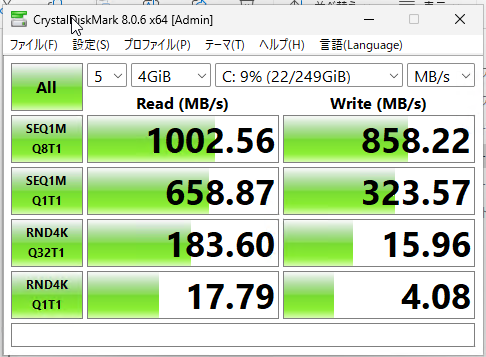
For sequential read, the performance fully utilizes the 10GbE bandwidth. Sequential write is 858MB/s, and although there is some performance degradation due to data synchronization within the HA configuration, the performance over the 10GbE connection is satisfactory.
VM Behavior When Failover Occurs in HA Configuration
Since we have the opportunity, let’s check the behavior of the VM when failover occurs in the HA configuration.
To see if the Windows VM stops, I displayed the clock down to the second hand. (Here)
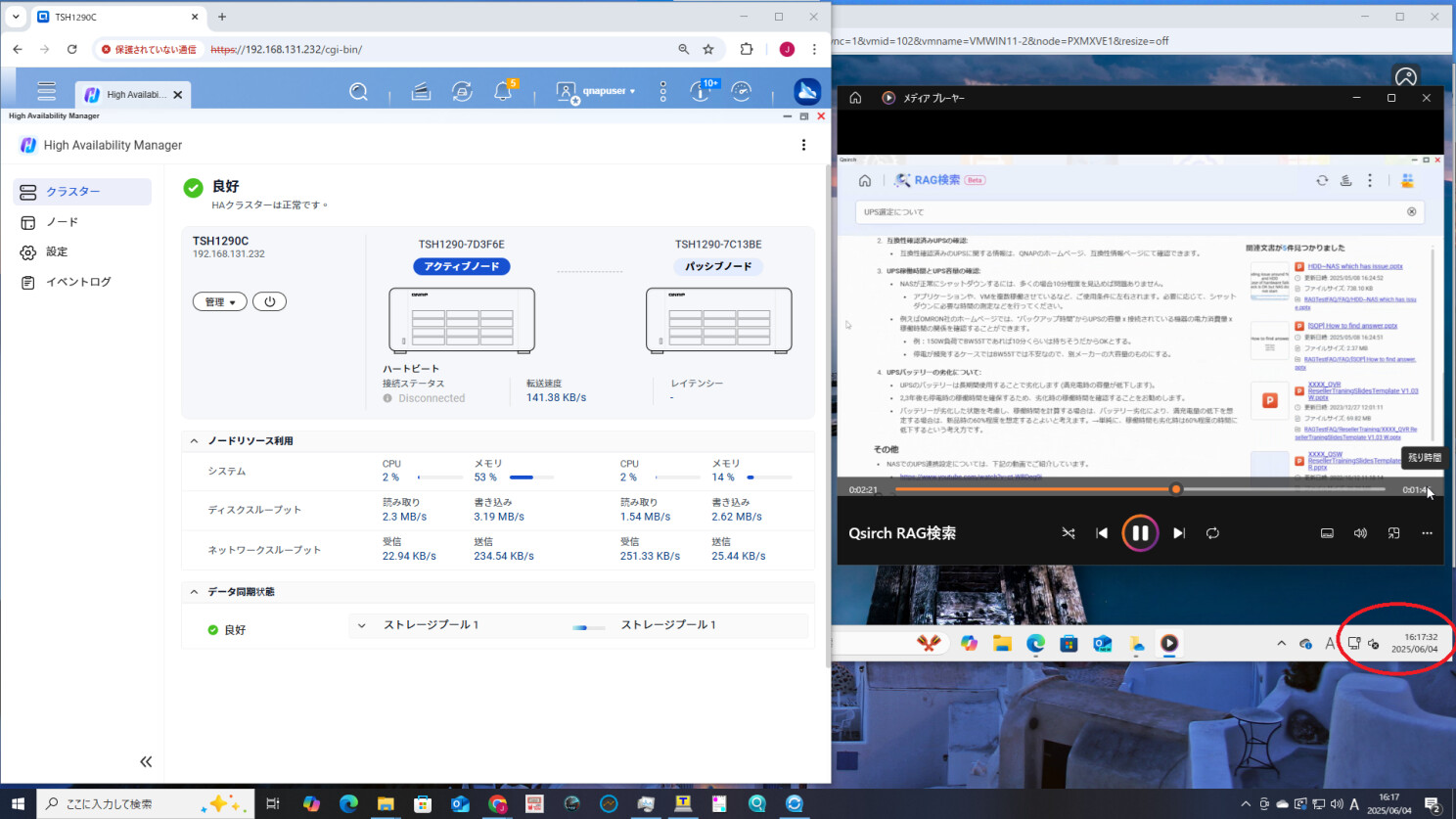
Also, to generate access to HA storage, I placed a video on the VM’s local disk and played it continuously. Here’s what happens when you unplug the main HA unit and failover to the sub unit.
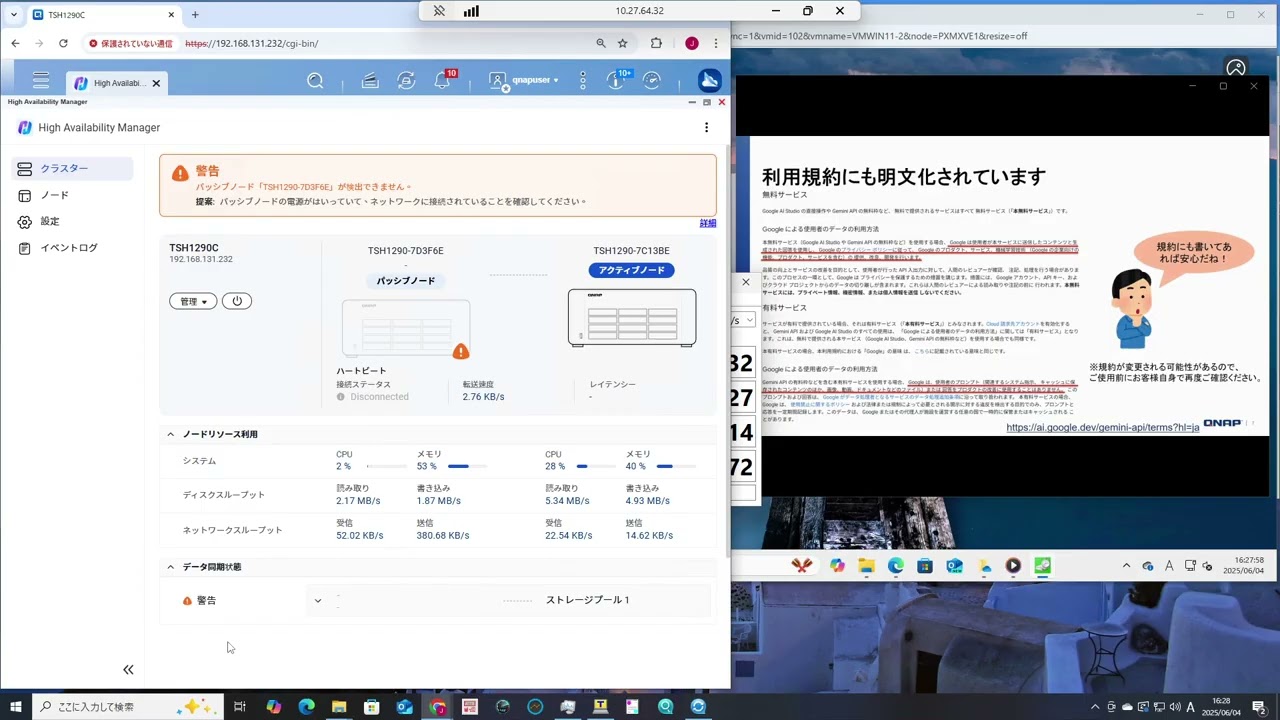
When failover occurs, the VM running on Proxmox VE itself does not stop, but when accessing data on the HA configuration including the local disk, IO wait seems to occur.
Of course, with a single node configuration, the VM itself would stop, so by configuring storage for Proxmox VE in HA, you can increase availability and operate VMs more safely. *Please note that results may vary depending on the environment and IO conditions.